Some of our coffees

Here are some of our coffees available for roasting and sale:

Honduras Paca Vita Organic


Producers: Silvestre Vasquez & Joel Lopez
Average farm size:
2 to 3 hectares
Altitude:
1340 – 1,700 meters
ASL
Processing types for export:
Mostly washed Arabica
Harvest: November
Honduras Reserva Pacavita, Organic
Following a brisk growth in production, this lush and mountainous country is now the
world’s third largest producer of washed Arabica. And the future looks bright.

Honduras has strengthened its already strong coffee industry with a commitment to revitalizing its
farms with new plantings. Offering a wide range of coffees, Honduras has recently
captured the attention of specialty roasters with high-quality beans treated with
care from the tree to the mill and beyond.


Reserva Pacavita
Rich Soils and Shady Trees


Surrounded by a diverse environment of biological reserves and mountain ranges, the
Pacavita region has ideal climatic conditions for growing coffee. Coffee plants grow in rich clay
soils, shaded by Inga trees, at elevations of up to 1,700 meters in this area of western Honduras.


Well-Defined Seasons
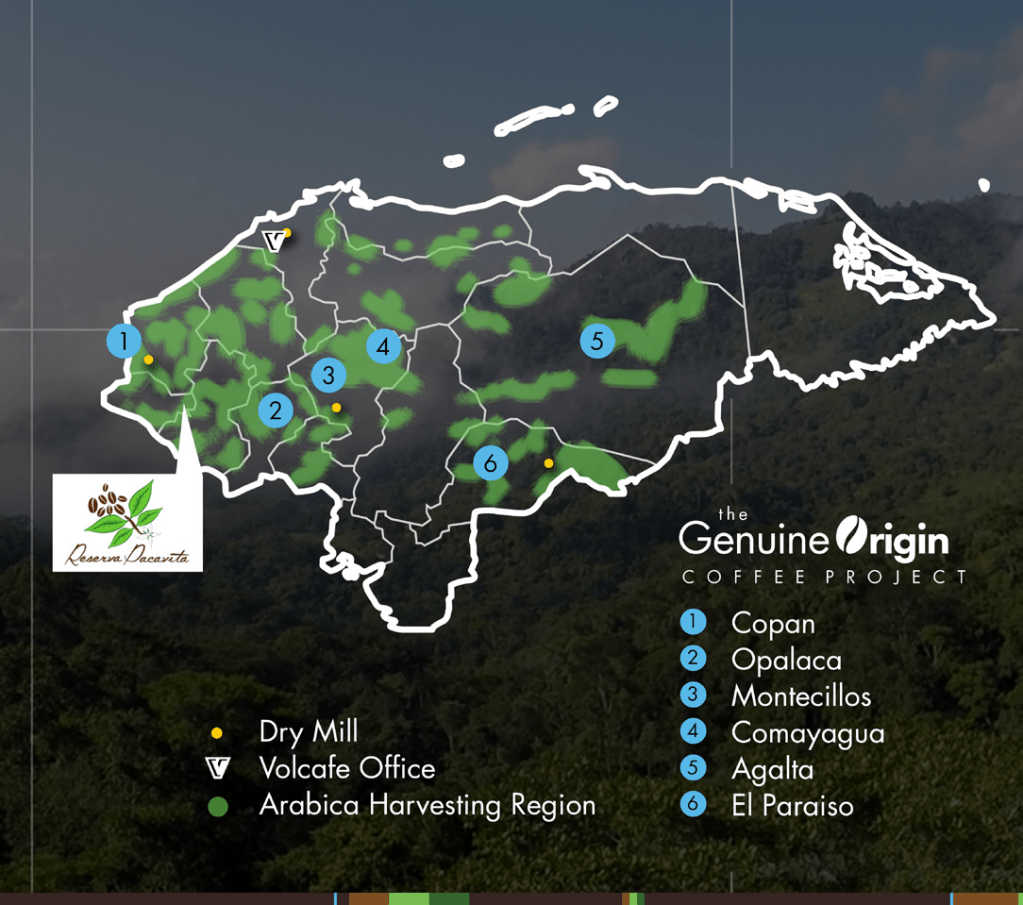
Paca Vita , Honduras


Well-defined seasons contribute to the quality of specialty coffees
from Pacavita. The rainy season results in beautiful cherries, and the
clear dry season allows farmers to sun dry them. The high-altitude
weather, rich clay soil, and warm sun ensure that the integrity and
quality of the beans is preserved from start to finish.
• TOPOGRAPHY: Located in the western part the country, the
area is surrounded by biological reserves and mountain ranges.
• CLIMATE: High altitude weather with excellent humidity and
adequate rainfall levels. Unlike other areas of Honduras, the
harvest season is dry, allowing for 100% sun-dried coffee.
• SOIL: Rich clay soils.
• ELEVATION: Steep slopes with elevations ranging between􀀁
1,100 to 1,850 meters ASL.
30 Years of Coffee Farming
Most farms in the area were established more than 30 years ago and
are between 2 and 3 hectares in size. Many are shaded by beautiful
Inga trees.( copy and images courtesy Genuine Origin Coffee Project, Volcafe’ Ltd.)

coffee-clip-art-1237562201214390563pitr_coffee_cup_icon.svg_.med_

whole- bean roasted coffee

Freshly roasted coffee beans 12 oz bags shipped via usps priority mail

$19.50

Click here to purchase.

COVID-19 coffee sales

We are selling at the Farmer’s Market, Online, though I like personal contact best. I do take the time to deliver locally in a contact free way. Postage varies though I can ship anywhere. I do NOT add nitrogen to my bags , yet, though I might if the net result is better storage.

Please feel free to let me know if you want some beans.

Year Two

Dear Friends,

I am starting year two in the coffee business. I am reviewing givens and druthers, things done and left undone, goals met and unmet.

I have had many thoughts , ideas , visions, goals. This coffee roasting enterprise is just one of them . I used to discuss my education ideas with my brothers, Tad and Paul.

I dreamt of an enterprise that would allow for experience , ( work experience ), education ( degree or certification – accredited ) combined with community and family.

I was disappointed in finding out it had been done before. ” Pygmalion in the Classroom ” . The Rubric of experiential education ( a la Mike Rowe ), Northeastern University’s Work/Study/Degree program , Outward Bound , of which I am a proud graduate of the HIOBS winter 1975 program , ( Hurricane Island ). Synanon, The Taize’ Communities , Packard Manse , the Christian Communes of the 1970s in the San Joaquin Valley of Central California and the Shaker communities of New England and the Ohio River Valley.

Then while married to Sally , in honor of learning to live anew and eager to learn, I thought about forming a healing corporation named The Pink House Foundation. I thought of using her brother as the P.A. for our clients . The Foundation would have served homeless , hard – to – house folks , young adults with few practical skills, turning hard to employ folks into taxpayers and successful business folk.

Then I started to learn to roast coffee….

The rest is history…….

More next time……

Cheers , and Happy New Year! ,

Brewster

Coffee and water

Coffees and waters are variables in your cup. Some municipal waters are great for coffee. Visalia California used to have really good, plentiful water. The aquifers were close to the surface almost artesian in well access. Unfortunately, the water sources have been drained through over-pumping of the aquifers and by the cutting of the gravel beds the water slips through to get to the valley towns as the water flows westward.

Socorro, New Mexico USA has an interesting water history using aquifers that have been contaminated by the mining industry and agriculture ( I did not state that for Visalia’s water, but the same applies there as well. ).

Water has markers such as Total Dissolved Solids ( or TDS) , “Hardness” or mineralization , flavor profiles ( yes, water has flavor profiles too).

Coffee prepared with “pure ” water ( filtered , reverse osmosis, or steam distilled) will have a different flavor or “bite” to it than coffee prepared with municipal or mineral spring water sources.

Arkansas’ s “Mountain Valley” brand spring water is my upscale favorite for brewing a top notch cup of joe. Next on the list, I found surprising, is the Topco grocery brand ( ” Food Club” ) of spring water sourced from the Hill country of Texas. Samantha Springs, Keller , Texas, or Caney Springs, Grapeland , Texas. Much cheaper and just as delicious ( hard , too).

I haven’t tried to brew a cup with the “Poland Spring” Brand ( Nestle’s owns it) of bottled water yet. It is sourced from the Dallas Plantation in Northern Maine ( I suspect from the Allagash water basin. )

So minerals are important for coffee flavor, have at it and let me know what you think. Cheers,

Life after Loss.

I cannot believe I started a business after losing Sally. At age 63 I formally incorporated a small business -coffee roasting- kind of like Colonel Sanders and his fried chicken..

Coffee , just beans , nothing fancy , purchased as ethically as I could afford ( the ” C” price of coffee as the commodity varies from $0.99-2.15, however , most of the times it hovers around $1.00 a pound ) Coffee costs $2.55 a pound to produce world wide(!).

Coffee mostly is subsidized by various governments. But the “Geisha” name associated with super expensive grades of coffee isn’t.

How can a small roaster compete with the roaster owned farms and NGO owned fair trade and free trade groups?

I am still working through that. I apologize to the Blog World for being all over the map. Will post more soon.

Thank you for all your business.!