Here are some of our coffees available for roasting and sale:
Honduras Paca Vita Organic
Producers: Silvestre Vasquez & Joel Lopez
Average farm size:
2 to 3 hectares
Altitude:
1340 – 1,700 meters
ASL
Processing types for export:
Mostly washed Arabica
Harvest: November
Honduras Reserva Pacavita, Organic
Following a brisk growth in production, this lush and mountainous country is now the
world’s third largest producer of washed Arabica. And the future looks bright.
Honduras has strengthened its already strong coffee industry with a commitment to revitalizing its
farms with new plantings. Offering a wide range of coffees, Honduras has recently
captured the attention of specialty roasters with high-quality beans treated with
care from the tree to the mill and beyond.
Reserva Pacavita
Rich Soils and Shady Trees
Surrounded by a diverse environment of biological reserves and mountain ranges, the
Pacavita region has ideal climatic conditions for growing coffee. Coffee plants grow in rich clay
soils, shaded by Inga trees, at elevations of up to 1,700 meters in this area of western Honduras.
Well-Defined Seasons
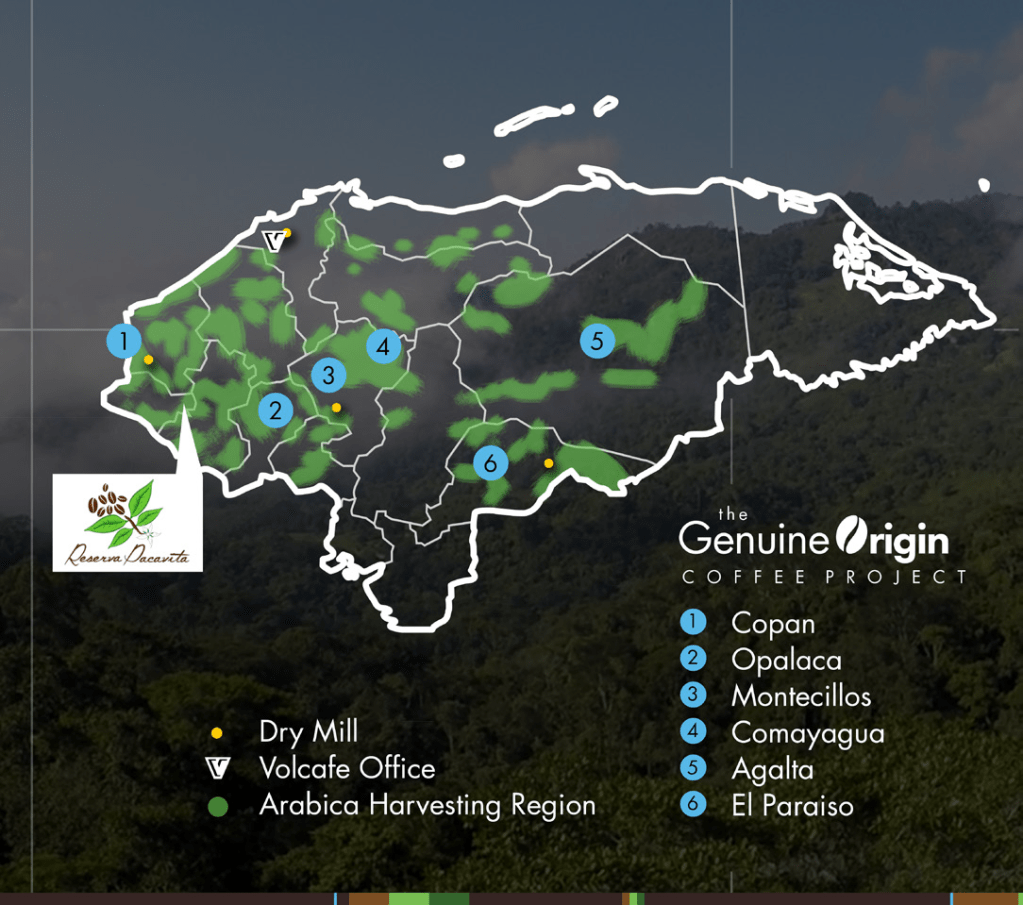
Well-defined seasons contribute to the quality of specialty coffees
from Pacavita. The rainy season results in beautiful cherries, and the
clear dry season allows farmers to sun dry them. The high-altitude
weather, rich clay soil, and warm sun ensure that the integrity and
quality of the beans is preserved from start to finish.
• TOPOGRAPHY: Located in the western part the country, the
area is surrounded by biological reserves and mountain ranges.
• CLIMATE: High altitude weather with excellent humidity and
adequate rainfall levels. Unlike other areas of Honduras, the
harvest season is dry, allowing for 100% sun-dried coffee.
• SOIL: Rich clay soils.
• ELEVATION: Steep slopes with elevations ranging between
1,100 to 1,850 meters ASL.
30 Years of Coffee Farming
Most farms in the area were established more than 30 years ago and
are between 2 and 3 hectares in size. Many are shaded by beautiful
Inga trees.( copy and images courtesy Genuine Origin Coffee Project, Volcafe’ Ltd.)

whole- bean roasted coffee
Freshly roasted coffee beans 12 oz bags shipped via usps priority mail
$19.50